NYFA’s Custom Built Facility
Teaching takes place within NYFA’s physical facility, custom-built for hybrid AI and physical production
The 4-Week In-Person AI Filmmaking Workshop at NYFA’s Cinematic AI Center is an intensive, full-time training program held at our dedicated Los Angeles facilities. Designed for aspiring filmmakers, visual storytellers, and digital creators, this program pairs traditional filmmaking disciplines (Writing, Directing, and Editing) with generative AI technologies.
Students learn narrative structure, scene craft, dialogue, blocking, coverage, and editorial pacing through both traditional craft perspectives and the agile generative loop: “write, visualize, repeat”.
Format and Duration: 4-Week, Full-time In-Person Workshop
Schedule: 15 hours per week of lectures, practical demonstrations, and on-set/lab exercises led by faculty.
3-hour optional Supervised Systems & Production Lab dedicated to project iteration, troubleshooting, and rendering.
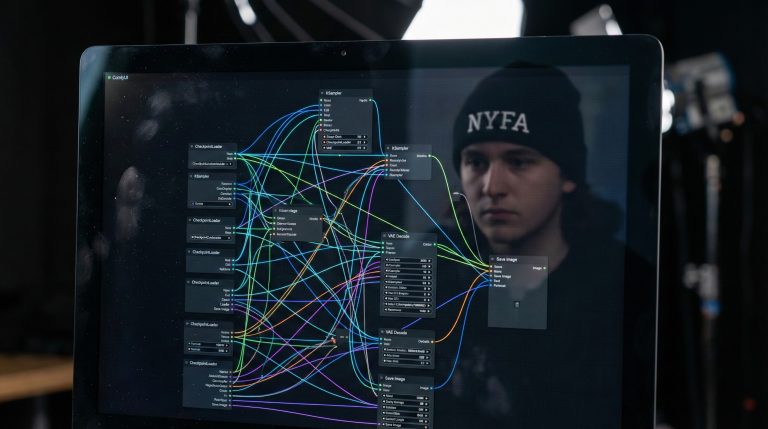
Faculty Model: Dual-Faculty Instruction. Classes are co-taught by two cross-trained instructors: one specializing primarily in traditional filmmaking and directing, and one specializing in AI systems and machine learning pipelines.
Lab Supervision: Friday lab sessions are monitored directly by faculty members or specialized AI laboratory technicians to support complex renders and node-based troubleshooting.
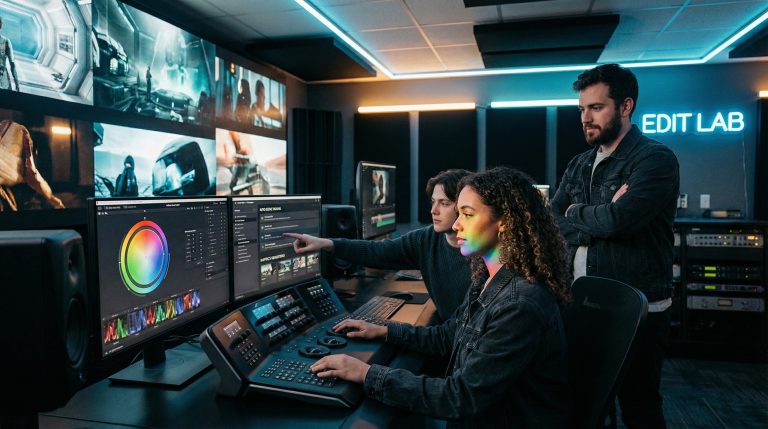
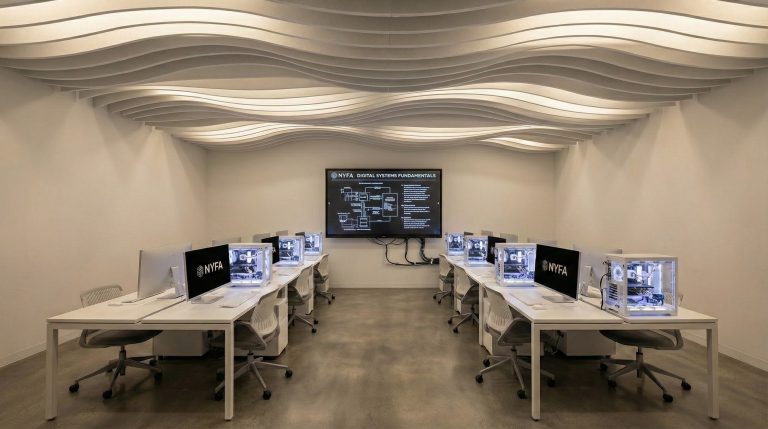
Teaching takes place within NYFA’s physical facility, custom-built for hybrid AI and physical production
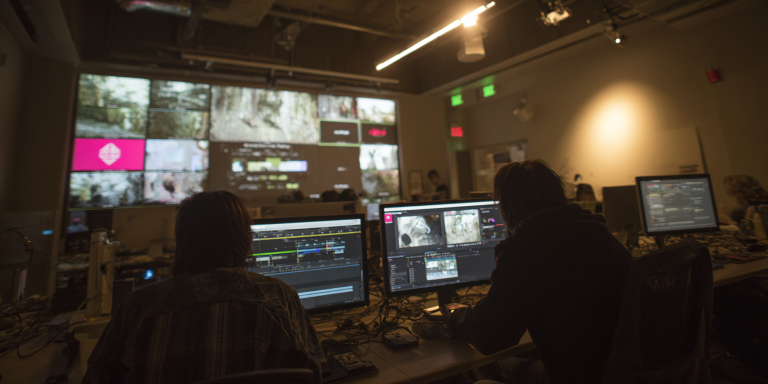
High-performance workstations featuring dedicated NVIDIA GPUs, dual monitors, drawing tablets, and direct connections to high-speed networked storage so students do not need to manage local file limits.
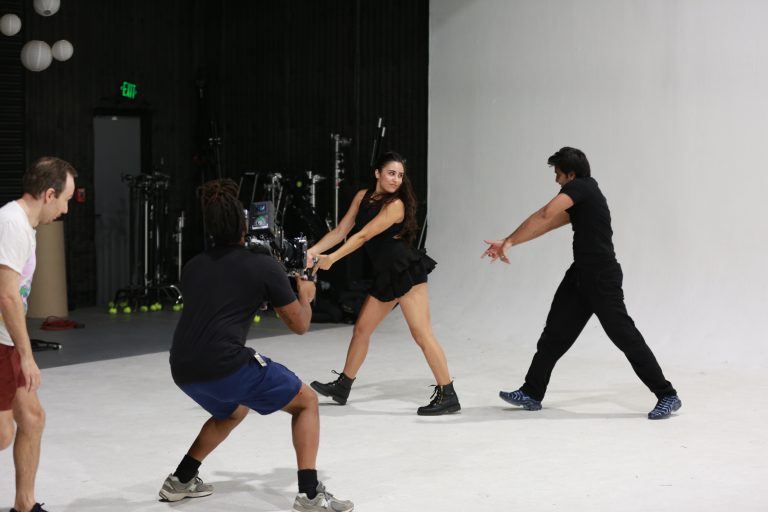
Soundstage spaces equipped with proxy sets and cyc walls used to shoot practical reference plates, acting reference, and lighting passes that feed directly into control networks and AI restyling pipelines.
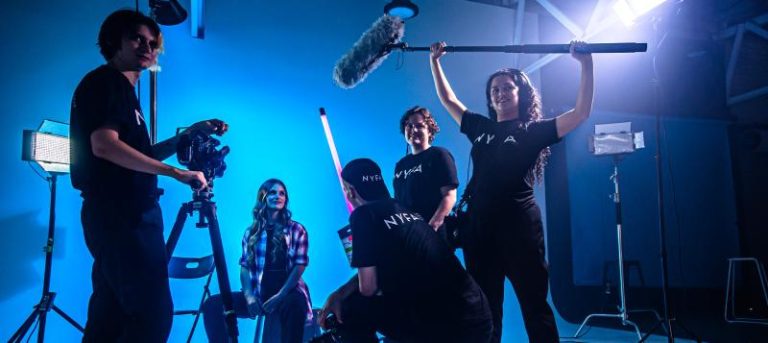
Acoustically treated spaces for recording pristine dialogue, performance reference, and synthetic voice model targets.
Introduces directorial intention and audience impact through camera placement, staging, blocking, and shot composition. Students translate scripts into beats, coverage, and cuts while directing live and synthetic talent. AI is integrated through look tests, previs passes, alternative coverage design, and rapid iteration.
Builds practical AI literacy for filmmakers. Covers diffusion fundamentals, latent space mechanics, managing visual drift, and promptcraft using film language (lensing, lighting, blocking). Students create styleframes, keyframes, LoRA datasets, and shot-based video workflows (text-to-video, image-to-video, video-to-video) while utilizing control inputs like OpenPose and Depth maps.
Teaches editorial rhythm, pacing, and screen direction alongside generative continuity challenges. Students practice “directing for the edit” by diagnosing story issues and creating targeted AI pickups. NLE discipline covers media organization, versioning, AI audio integration, color management, and final exports.
Focuses on story mechanics (theme, character, conflict, stakes) and screenplay syntax. Students practice an outline, pages, visualization, and revision feedback loop using AI for ideation while retaining human authorship.
To receive a Certificate of Completion, students must complete three major projects:
Grading is split evenly across the four core areas of study:
Workstations in the Genesis Lab come pre-configured with a dual-stack software suite combining traditional post-production tools, cloud-based generative platforms, node-based local engines, and custom proprietary pipelines.
Final platform selections are confirmed prior to the start of each workshop cycle to reflect the latest model updates and industry releases.
Students learn to evaluate, select, and prompt across leading generative AI platforms:
| Location | Program Start Date and End Date | Tuition | |
|---|---|---|---|
| Los Angeles | October 19, 2026 – November 13, 2026 January 25, 2027 – February 20, 2027 June 7, 2027 – July 3, 2027 July 6, 2027 – July 31, 2027 September 13, 2027 – October 9, 2027 | TuitionTuition:$2,500 Departmental Program Fee:$500 | |